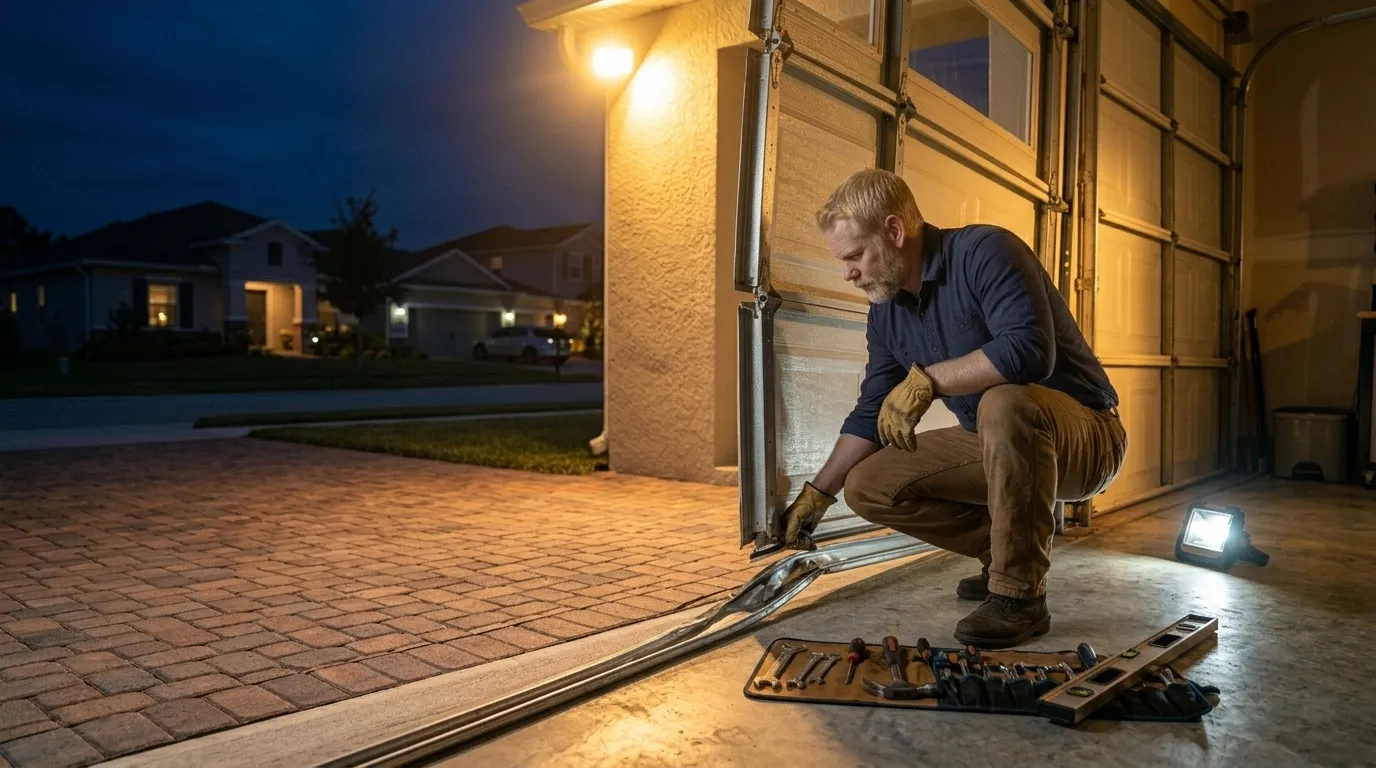
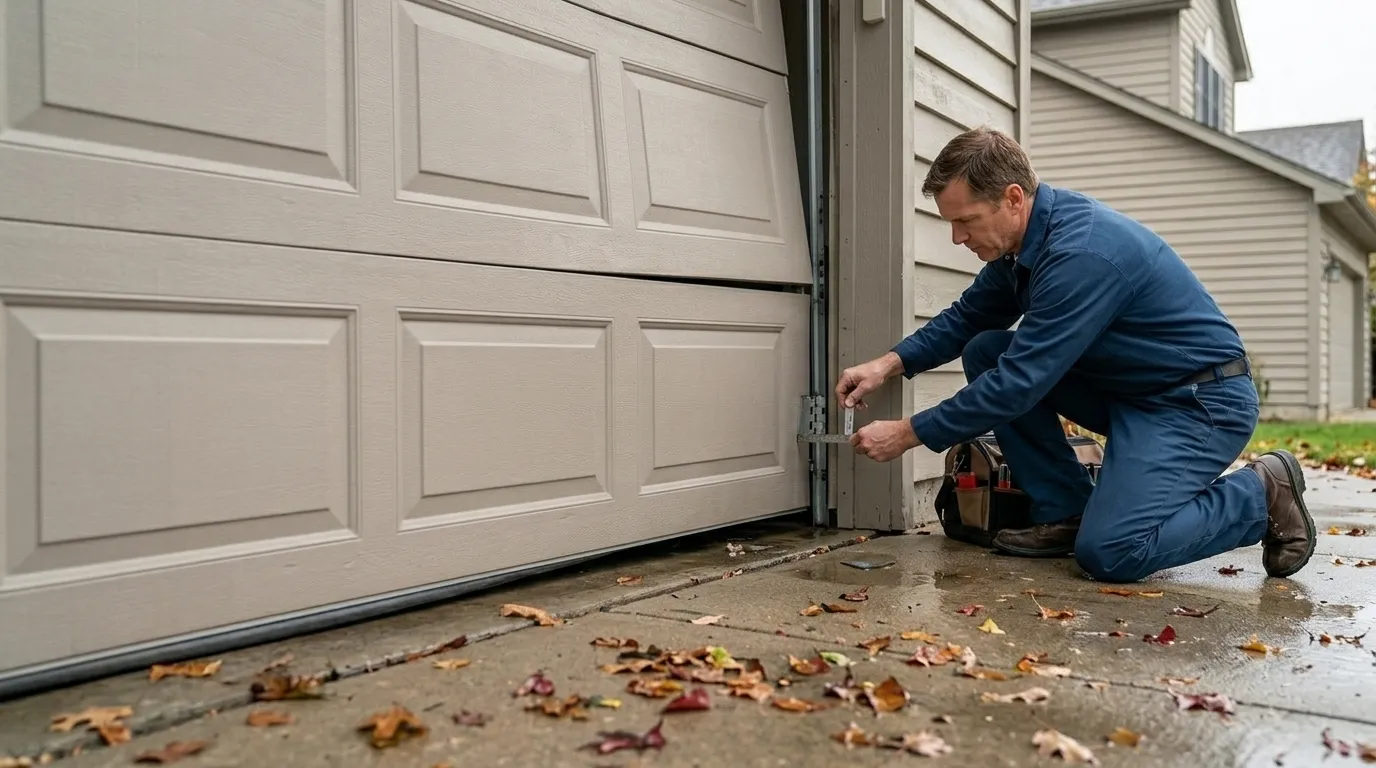
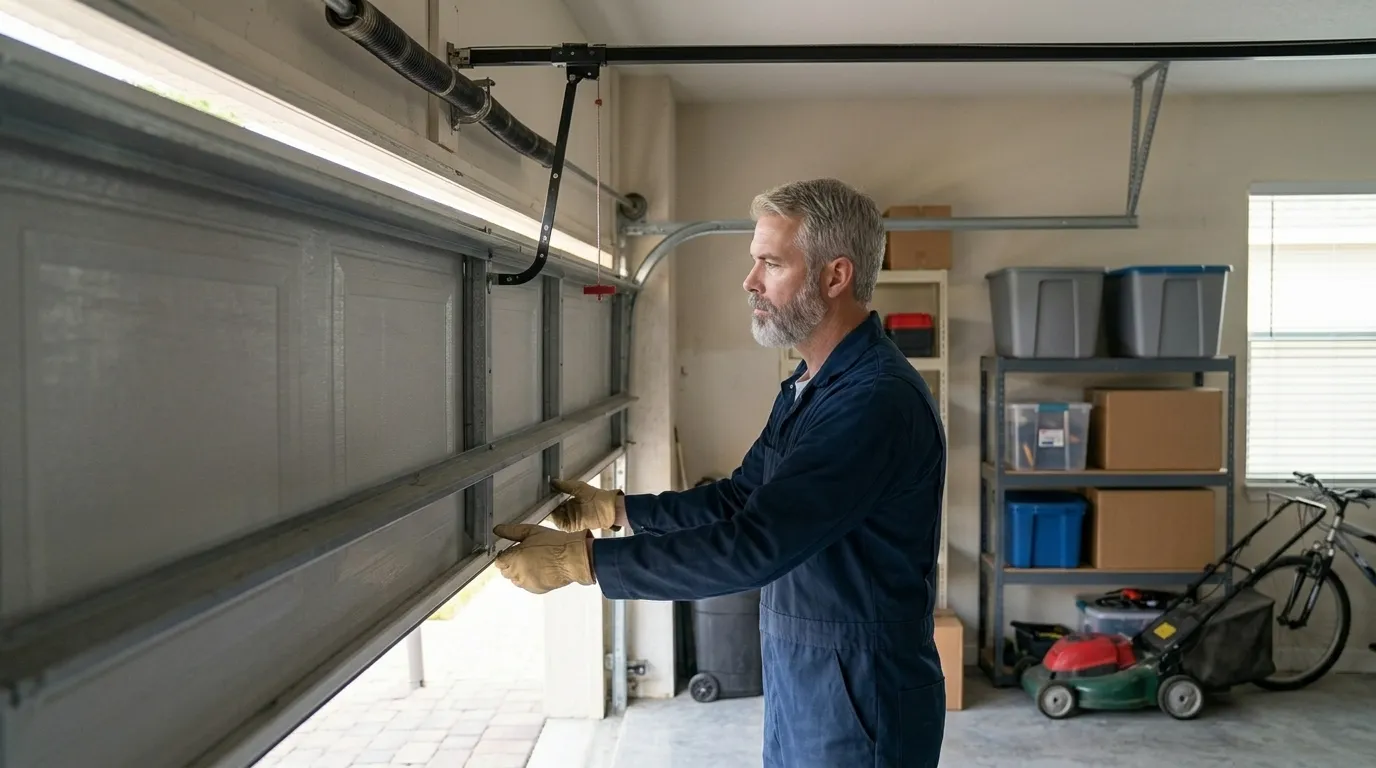
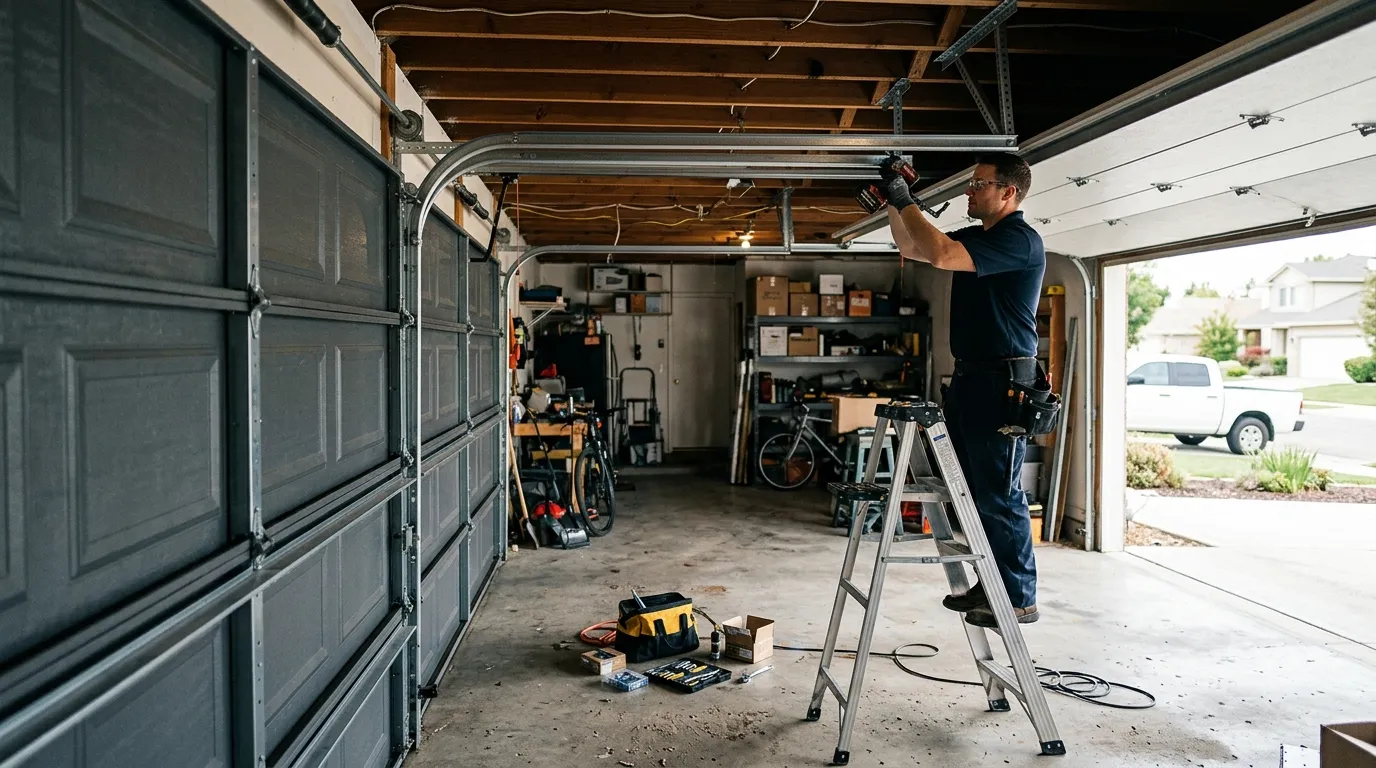
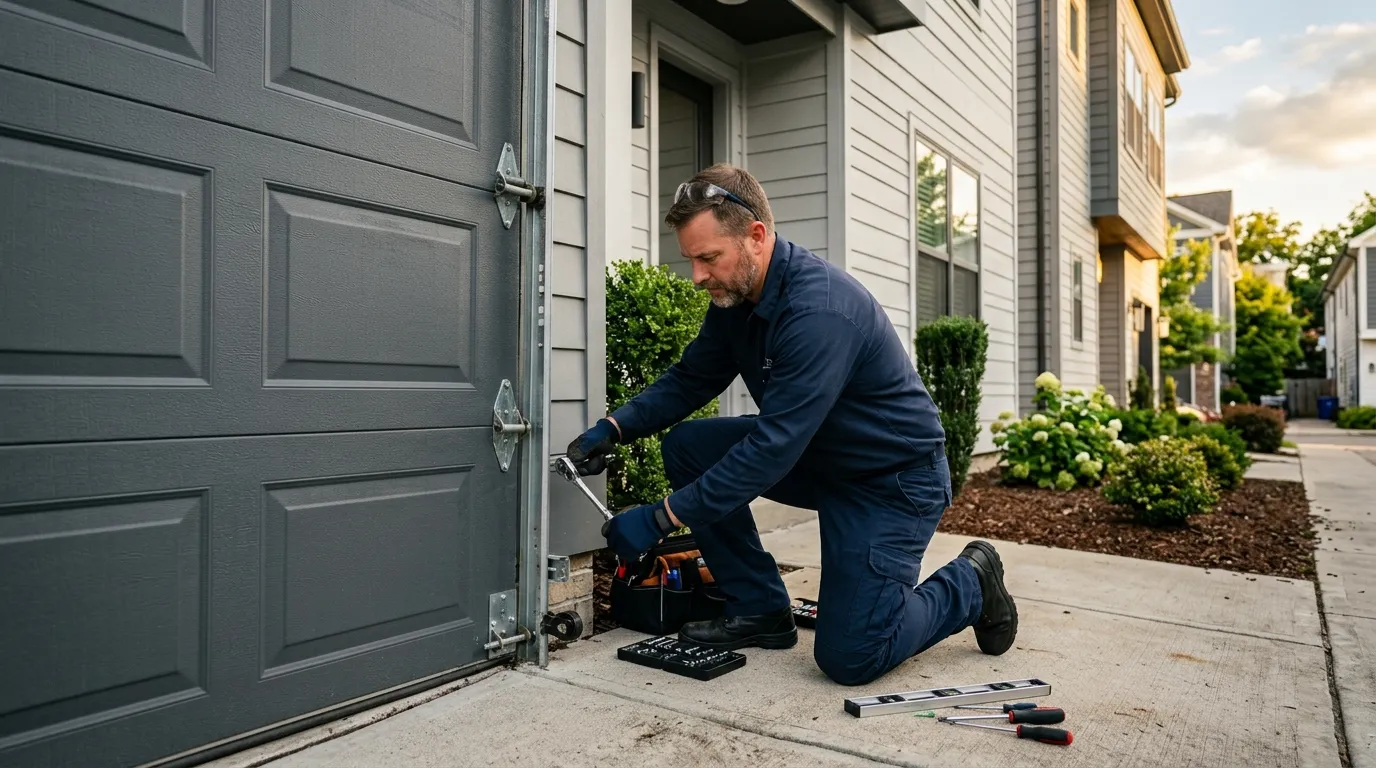
If the door is hanging at an angle, if a cable has come off the drum, or if you can see daylight between the roller and the track on one side, stop opening it and call. Garland's housing stock runs 1973 to 2013 with the median build year around 2002, so most doors in this area are still on their original galvanized track and stamped-steel rollers rather than nylon. Those tracks bend instead of snapping, which means a door can look like it's still working right up until it isn't. If the opener strains, reverses partway, or the door binds and pops free again on its own, that's a track already out of true, not a fluke. We don't recommend forcing a door back onto bent track by hand - the horizontal-to-vertical curve is set to a tolerance that's hard to eyeball, and a second attempt often bends it further or drops the door off the rollers entirely. At that point it's a service call, not a DIY fix, and waiting usually turns a track adjustment into a track replacement.
How Local Conditions Play In
Garland sits in a moderate-heat climate band, which doesn't mean mild - it means real swings between a cold morning and a 95-degree afternoon, sometimes in the same week. Steel track expands and contracts with that swing, and the mounting brackets holding it to the framing do the same at a slightly different rate. Over enough cycles, lag screws work loose in the wood jamb and the track walks a fraction of an inch away from true. On a door with two vertical tracks, even a small drift on one side changes how the rollers sit, and that's when a roller starts riding the edge of the track instead of the channel. This isn't a defect in any one door - it's what happens to track and hardware installed in the 2000s, which describes most of the housing across this service area, after two decades of that heat cycle without anyone re-checking the bracket bolts.
What to Check
Before you call anyone, look at three things. First, the brackets holding the vertical track to the door frame - grab each one and see if it moves independently of the wall. Second, the horizontal track in the ceiling, where it curves down toward the wall track; sag here usually means a hanger strap has stretched or come loose. Third, look at the bottom roller on each side with the door down - they should sit centered in the track, not pressed against one wall of the channel. If you own a house in one of the 2000s-built subdivisions common through this area, this hardware has likely never been touched since the builder installed it, and a once-a-year check of these three points catches most drift before it becomes a jump. What we can't tell you from a checklist is the exact torque those brackets need - that varies by door weight and track gauge, and guessing wrong strips the wood.
What Is Going On
Most of the off-track calls we see trace back to one of two things: a bent section of track from an impact - a car bumper, a bike, a gust that caught the door mid-cycle - or slow bracket drift from years of heat expansion on original hardware. Given how much of the local housing dates to the 1973-2013 build window with a heavy concentration in the 2000s, the second cause shows up more than people expect, because it doesn't announce itself with a bang. It shows up as a door that's slightly harder to open than it was last year, then one that rattles on the way down, then one that jumps. We straighten and re-anchor track where the metal and the framing allow it. Where the track is kinked hard enough that it won't hold a true line - which happens more with impact damage than with drift - replacement is the honest answer, even though it costs more than a repair call.
How it works
From “it’s stuck” to “it’s fixed”
A quick, honest process - no guesswork and no surprises.
1
Tell us what’s wrong
Describe the symptom - won’t open, loud bang, opener runs but the door won’t move.
2
On-site diagnosis
A technician tests the door under power and by hand and finds what actually failed.
3
Clear, up-front plan
You get the fix that’s needed and what drives the cost - before any work starts.
4
Repaired & tested
The repair is done, the door is set true and tested, and the work area left clean.
Serving Garland, TX - tell us what your door’s doing and we’ll take it from there.
Can I push a garage door back onto the track myself?
You can sometimes reseat a roller that's popped just off the edge, with the door fully down and the opener disconnected. But if the track itself is bent, forcing the door back on usually just shifts the bend somewhere else. If it doesn't slide back on with light hand pressure, stop and call.
Why does this happen more in summer here?
Garland's climate band runs moderate-heat with real swings between morning and afternoon temperatures. Steel track and its mounting brackets expand and contract at slightly different rates through those swings, and over years that works screws loose in the door frame, letting track drift out of alignment.
Is this a problem with how my house was built?
No - it's a function of age, not a defect. Most homes in this area were built between 1973 and 2013, with the 2000s being the heaviest stretch. Original track and hardware from that era have simply had two decades of heat cycling without anyone checking the bracket bolts.
How do I know if it's the track or the opener?
If the door jumps, binds, or hangs crooked with the opener disconnected and the door moved by hand, the problem is the track or rollers, not the opener. If it only misbehaves when the opener runs, that's a separate issue worth mentioning when you call.
Ready to get your garage door sorted?
Tell us what it’s doing and where you are in Garland - we’ll take it from there.