Why This Fails Locally
Most of the housing across this service area went up between 1973 and 2013, with the median build year landing around 2002 - the 19 named communities we cover are mostly 2000s stock. That matters for springs specifically: torsion springs are rated for a set number of open-close cycles, typically somewhere around 10,000, and a spring installed when a house was built in the early 2000s is now two decades into daily use. That's exactly the age band where original springs start reaching end of life, regardless of how well the door was maintained. Add the local climate - this area sits in a moderate-heat band, meaning the springs cycle through hot Texas summers where metal expands and the coating on cheaper factory-grade springs breaks down faster than it would somewhere cooler. Garages here also run hotter than the rest of the house for months at a time, which speeds up spring fatigue whether or not anyone notices. So the pattern we see again and again isn't damage from an accident - it's a spring rated for roughly a decade of normal use, installed when the house was new, finally reaching the end of its rated cycle life at the same time across a whole neighborhood built in the same few years.
What You Are Seeing
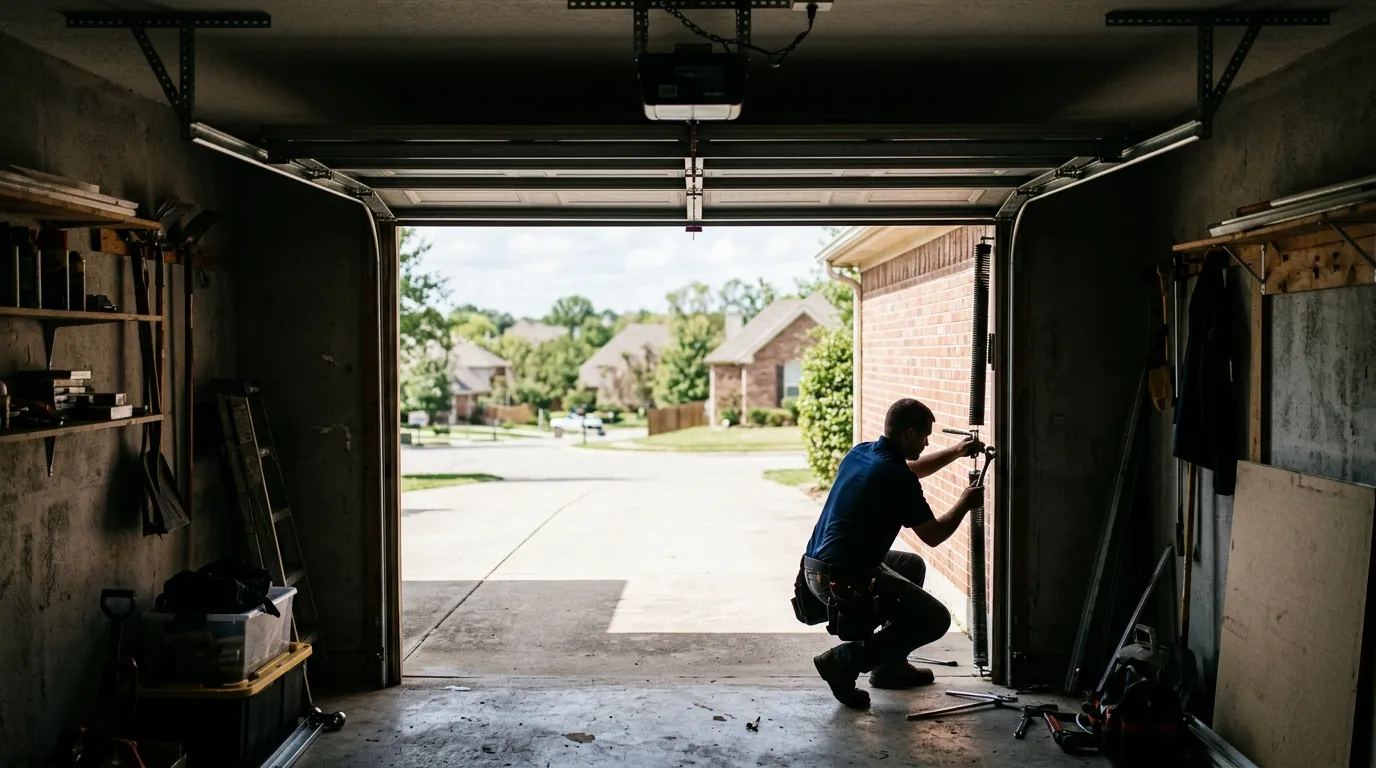
A torsion spring that's about to go usually gives you a warning: the door feels heavier lifting by hand, the opener strains and makes a louder motor sound than usual, or you notice a gap in the coil above the door when you look closely. When it actually breaks, you'll usually hear it - a loud bang from the garage, often mistaken for something falling or even a small explosion. After that, the door will not stay up on its own, and an opener trying to lift a door with no spring tension will strain the gears or the drive belt, turning a spring job into a bigger repair if you keep running it. Extension spring failures look different - a snapped cable or a spring hanging loose along the track, sometimes with the door stuck halfway. Either way, the door with a broken spring is under no controlled tension, which is why we say don't force it open or closed by hand or with the opener until it's fixed.